

Table of Contents
- The problem
- Operational and financial consequences
- Common mistakes
- The method: diagnose before you transform
- Best practices
- A concrete example
- The answer Diagnoz® provides
- FAQ
- Take action
The problem
Many companies want to transform, modernize their tools, or adopt new technologies without a clear view of their actual starting point. Decisions end up based on individual impressions, data scattered across multiple files, or questionnaires too generic to be genuinely useful. Leadership, business units, and IT often start with diverging views of what should change first — and nobody has an objective measure of the organization’s real maturity.
Operational and financial consequences
This lack of clear vision leads to misdirected investments, too many projects launched in parallel, poor adoption of deployed tools, delays, and budget overruns. The most common symptom: a transformation disconnected from the organization’s real needs, consuming budget and energy without producing measurable value.

Common mistakes
- Running a one-off, expensive audit with no repeatable method to track progress afterward
- Confusing a single overall score with real understanding — two organizations can score similarly while facing radically different problems
- Producing recommendations that are hard to act on, with no prioritization or concrete plan
- Letting IT drive the transformation alone, without involving business units or leadership
- Never reassessing maturity over time, which makes it impossible to measure the value actually created
The method: diagnose before you transform
A structured approach relies on a continuous cycle: assess, understand, compare, prioritize, recommend, plan, and track. This cycle spans twelve domains: strategy and governance, organization and processes, information systems, data and Business Intelligence, artificial intelligence, ERP and CRM, customer experience, cybersecurity and compliance, and skills and change management.
Each dimension is scored on a maturity scale, from initial (informal practices) to optimized (advanced data- and AI-driven steering). The target level depends on strategy, resources, and real needs — not every organization needs to reach the maximum level on every dimension.
Best practices
- Systematically cross-reference the maturity score with business urgency, risk, and implementation effort — a score alone is never enough to prioritize correctly
- Involve multiple respondents (leadership, business, IT) to avoid a biased view
- Turn every finding into an action assigned to an owner, with a deadline and a success indicator
- Reassess periodically to measure real progress, not just declared advancement
A concrete example
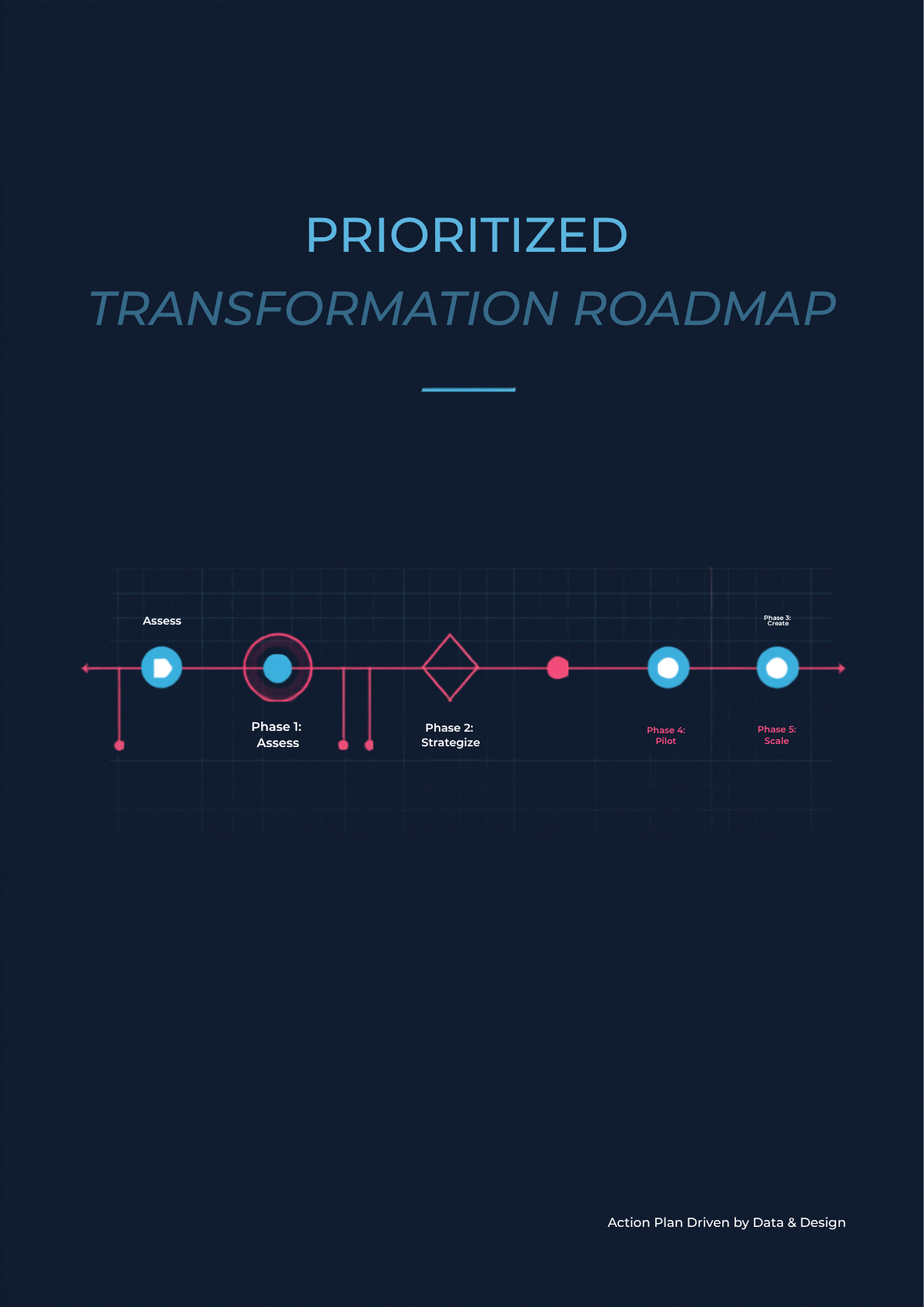
A company wants to modernize its information system and grow its use of data. A structured diagnostic reveals an ERP poorly suited to actual needs, largely manual processes, conflicting versions of the same KPIs across departments, weak data governance, and BI skills concentrated in a single person. The resulting recommendations: formalize data governance, secure the critical skills identified as a risk, rationalize reporting, evaluate the ERP’s evolution, automate priority processes, and put a change management plan in place. These recommendations then become a roadmap, with assigned owners and tracking over time.
The answer Diagnoz® provides
Diagnoz® turns this method into a platform: intelligent questionnaires, automated analysis, interactive dashboards, contextualized recommendations, and a trackable roadmap. The platform doesn’t just produce a score — it helps the organization understand its situation, define its priorities, and track progress over time, with a built-in assistant that explains questions, helps interpret scores, and suggests next actions without ever replacing human judgment.
FAQ
Is a single maturity score enough to prioritize a transformation?
No — two organizations can score similarly while facing very different problems. The score should always be cross-referenced with urgency, risk, and implementation effort.
Do you need a consulting firm to run this diagnostic?
Not necessarily for a first assessment — a structured platform like Diagnoz® lets you run it internally, while remaining compatible with human support on priority initiatives.
How often should maturity be reassessed?
A periodic reassessment — typically annually or after a major initiative — lets you measure real progress rather than declared progress.
Take action
Assess your organization’s maturity and turn your findings into a roadmap. Discover Diagnoz®, 7-day free trial.